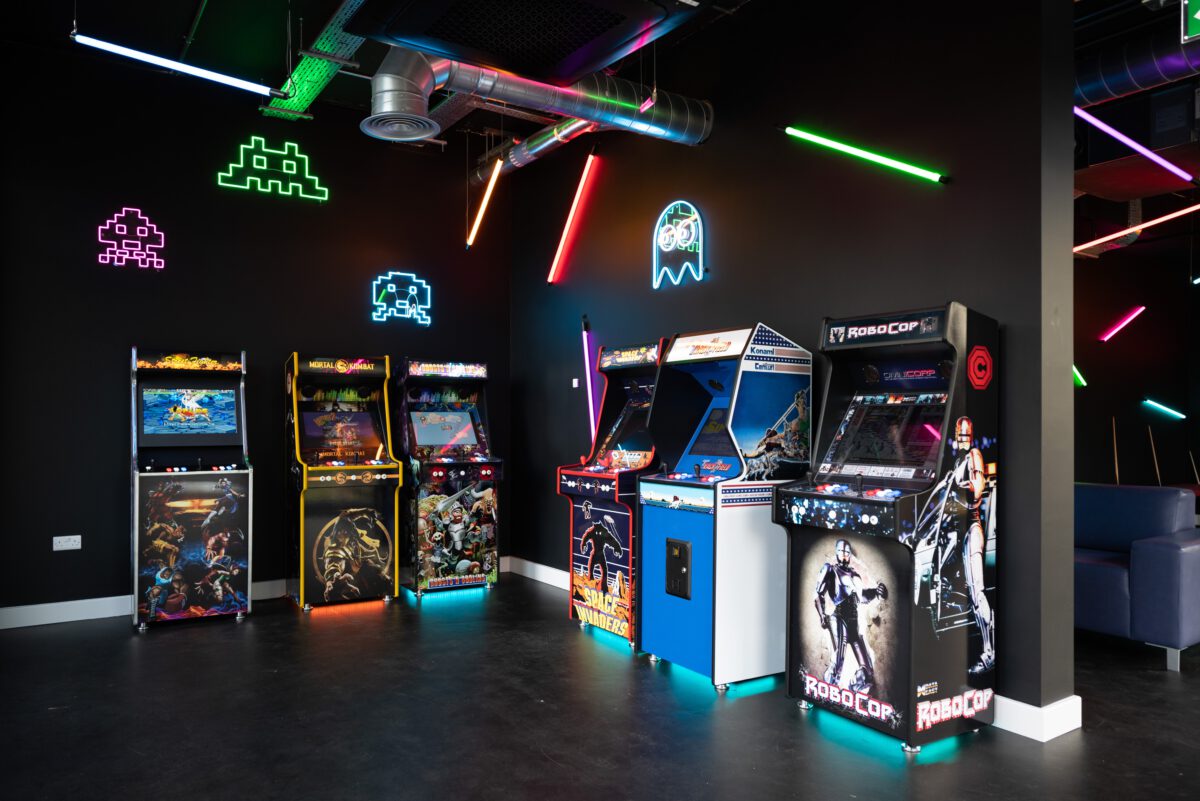
Arcade machines—these iconic video game cabinets that began their rise in the late 1970s and were found in nearly every arcade throughout the 1980s—have lost none of their fascination to this day.
They are considered milestones in the development of modern video games and reflect the technological, social, and cultural currents of their time. As places of social interaction and digital innovation, they shaped an entire generation of players.
In this article, we take a look at the exciting history of arcade machines, their significance in pop culture at the time, and their role in today’s retro gaming trend.
The beginning of the gaming era
The history of arcade machines begins in the early 1970s, a time when digital entertainment was still in its infancy. The starting signal came in 1971 with the first commercially successful arcade machine: Computer Space. Developed by Nolan Bushnell and Ted Dabney, later the founders of Atari, this game marked the beginning of a new era in interactive entertainment.
Just one year later, Pong was released—a simple yet groundbreaking table tennis game that quickly became a cultural phenomenon. It made arcade games accessible to a broad audience for the first time and laid the foundation for the industry’s global rise.
The success of these early games was not due to gameplay alone, but also to their technological innovations. While Computer Space relied on complex hardware, Pong impressed with its intuitive and easily accessible game mechanics. Its simple black-and-white graphics enabled direct, fast-paced interaction and established a core principle of arcade games that remains relevant today: instant fun without a steep learning curve.
The early successes of Computer Space and Pong marked the beginning of the golden age of arcade games. They laid the foundation for technological advancement and the cultural integration of video games into mainstream society.
These games were not only economically successful for operators and developers, but also a turning point in pop culture. They initiated the rise of a new, global gaming culture whose influence extended far beyond arcade halls.
The initial spark ignited by these first arcade titles grew into a worldwide enthusiasm that would shape the medium of video games for decades to come.
The golden age of arcade gaming machines
In the 1980s, arcade games reached an unparalleled peak in popularity and cultural significance. This era, often referred to as the “golden age” of arcade machines, witnessed the birth and rise of games that not only introduced innovative technologies for their time, but also created world-famous, iconic figures in pop culture. Popular titles such as Pac-Man, Space Invaders, Donkey Kong, and Galaga revolutionized the gaming world and became cult classics that captivated people of all ages.
For example, Pac-Man: Developed by Namco in 1980, the game offered a relatively simple yet highly addictive gameplay mechanic that quickly turned it into a global phenomenon. It was remarkably unique in that it differed from the typical shooter-based games of the time and placed a character at the center of the experience—one that is now considered one of the most recognizable symbols in gaming history.
Space Invaders, another pioneer, also reached its absolute peak in the 1980s in terms of popularity, technological innovation, and cultural relevance. This decade is rightly regarded as the golden age of arcade machines.
In dieser Zeit entstanden nicht nur technisch wegweisende Spiele, sondern auch legendäre Figuren, die bis heute fester Bestandteil der Popkultur sind. Titel wie Pac-Man, Space Invaders, Donkey Kong oder Galaga revolutionierten die Videospielwelt und wurden zu zeitlosen Klassikern, die Generationen von Spielenden begeisterten – unabhängig von Alter oder Herkunft.
Arcade halls of that era were hubs of social interaction, places of competition, and sites of early digital community experiences. They paved the way for what is now a global gaming culture. Space Invaders, a defining title of this young gaming era, introduced a new level of strategic depth and competition to arcades by confronting players with waves of attacking enemies that had to be defeated through skill and concentration.
Donkey Kong, created by Nintendo in 1981, even introduced complex narrative structures and character development to the arcade game scene—an idea that was largely unestablished in video games at the time. The game also marked the birth of Mario, a character who would later become one of the most recognizable faces of Nintendo.
Galaga, another groundbreaking game released in 1981, expanded on the concept of Space Invaders by adding new features, such as the ability for the player’s ship to be captured by enemies. This innovation further deepened gameplay, strategy, and overall enjoyment.
All of these games were technologically advanced for their time, featuring improved graphics and more complex control systems that created an immersive experience. They were not merely forms of entertainment, but also artistic expressions, using fast and direct gameplay to reward players instantly and encourage repeated visits to arcades. Their accessibility and low cost per play attracted a broad audience and made arcade gaming a fixed element in snack bars, shopping centers, and purpose-built arcade halls.
This golden age of arcade machines was not only a time of technological innovation, but also a significant cultural phenomenon. The excitement and sense of community fostered by these machines shaped an entire generation and left a legacy that continues to live on in today’s gaming culture.
These classics all helped shape the landscape of entertainment media and established video games and gaming as a popular and enduring form of entertainment.
Technological development and decline
As computer technology advanced, arcade games also became increasingly sophisticated. Color graphics, improved sound effects, and ever more complex gameplay elements characterized the continuous evolution of this popular form of entertainment.
However, toward the end of the 1980s and the beginning of the 1990s, a noticeable shift emerged. The traditional appeal of arcades began to fade as powerful home consoles and PCs became more affordable and offered comfortable alternatives for playing at home.
This transition marked the gradual decline of traditional arcade culture, whose golden era was slowly replaced by the console boom and the growing PC market.
The role of arcade machines today
Today, arcade machines are experiencing a remarkable renaissance. Driven by nostalgia among older generations and growing interest in retro-oriented entertainment among younger players, they are once again gaining popularity. Modern arcades, often referred to as barcades, combine classic arcade flair with a relaxed bar atmosphere and are evolving into popular social venues.
These locations rely on a balanced mix of classic arcade titles and modern games to appeal to both retro fans and new generations of players.
Since the 1980s, arcade machines have undergone a multifaceted evolution. They reflect not only technological innovation but also broader social and cultural change. From simple pixel-based games to today’s retro culture, they remain a core part of video game history and a living symbol of digital pop culture.
Whether in a modern barcade or in a nostalgic film, the magic of arcade machines lives on and continues to inspire new generations of players around the world.
The rediscovery and revival of arcade halls
In recent years, indoor playgrounds and arcade halls have experienced an impressive renaissance. This trend is driven by growing nostalgia among older generations as well as renewed interest among younger people in retro-oriented leisure activities. While many visitors from the 1980s seek familiar experiences, younger audiences are discovering the appeal of pure, direct gameplay beyond consoles and smartphones.
Modern gaming venues, often known as barcades, combine classic arcade fun with a stylish bar atmosphere. This blend of entertainment and socializing has proven highly successful and appeals to a broad target audience.
Guests immerse themselves in a time when the clicking of joysticks and pressing of buttons created genuine moments of connection. At the same time, these venues offer a welcome break from everyday digital life and allow a return to a simple, analog gaming experience.
Alongside classic arcade games, many of these establishments also embrace new technologies. Modern arcade machines enhance the nostalgic offering with contemporary features, further increasing their appeal for tech-savvy visitors. This evolutionary development creates an exciting bridge between past and present.
As part of the digital detox trend, such venues have become popular destinations for those who value physical interaction and real social exchange. The rise of urban gaming spaces clearly demonstrates the enduring desire for authentic connection and entertainment—and how successfully the classic arcade experience can be integrated into today’s leisure landscape.